Allowances vs. Actual Costs: How Remodel Budgets Drift by $25,000
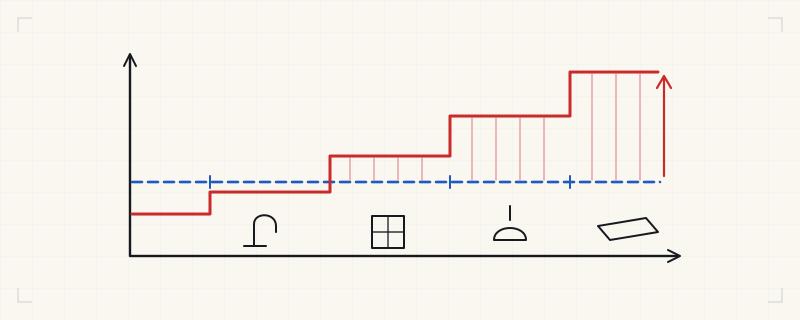
When a remodel ends up $25,000 over budget, people assume something big went wrong. Usually it didn't. It was $400 here and $1,200 there, spread across dozens of finish choices.
Your builder's estimate has allowances in it. Maybe $4,000 for primary bath tile, $1,500 for decorative lighting, $8,500 for appliances and $1,200 for cabinet hardware. Those are placeholders. They are not what you're going to spend unless you happen to pick things that cost exactly that much.
And in the showroom, every upgrade sounds reasonable. The faucet is only $350 more. The honed quartzite is $2,200 more, but you're going to look at it every day. I get it.
The trouble is that almost nobody can keep a running total in their head across forty decisions and four months. You find out when the invoices show up, and by then the material is ordered or already on the wall. Then the homeowner feels blindsided, and the builder gets blamed for things the homeowner asked for.
What helps is boring. For every item, write down the allowance, the price of what you picked, and later what you were actually billed. Keep a total for the whole project where you can both see it.
Then you can trade. If you know you're $4,100 over in the kitchen today, you can keep the quartzite you love and choose a simpler tile for the guest bath. You're allowed to splurge. You just want to know you're doing it.
Track allowances, option estimates, actual costs, and invoices in one workspace.